
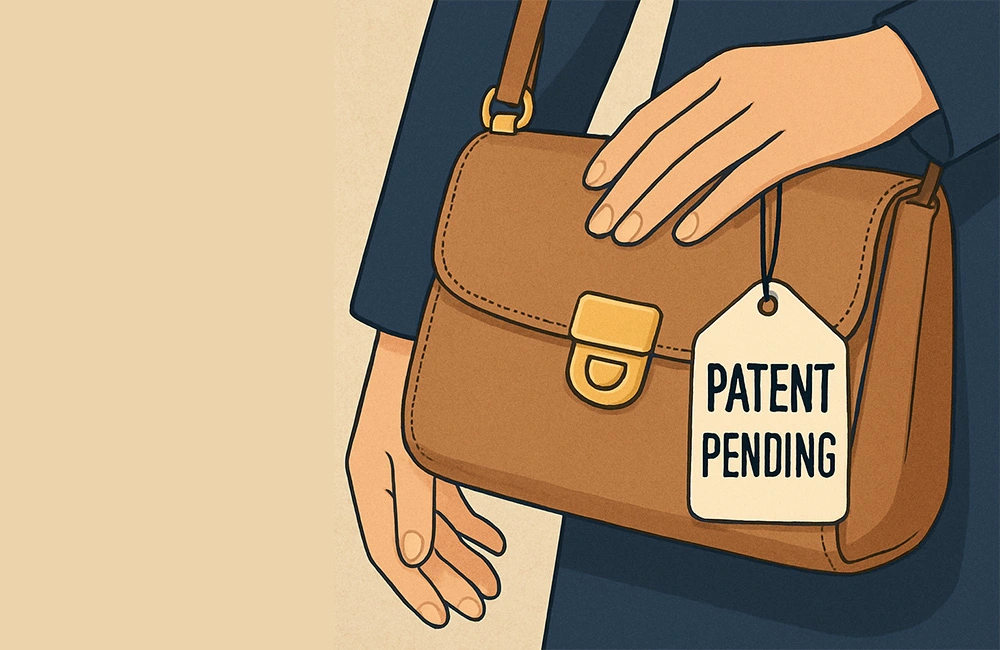
When you encounter a product such as a bag labeled “Patent Pending,” it might seem like just another marketing flourish. However, this small label carries significant legal, commercial, and strategic weight. It signals that the creator of the bag, or the creator of one of the features of the bag, has filed a patent application with a relevant patent office, such as the United States Patent and Trademark Office (USPTO) in the United States (U.S.) or the European Patent Office (EPO) for the European Union (EU). However, it is crucial to remember that by just filing a “patent pending” application, a patent has not yet been granted. Thus, comprehending the meaning behind “patent pending” is crucial not only for inventors and companies but also for consumers, competitors, and potential investors.
What Does “Patent Pending” Mean?
At its core, “patent pending” signifies that the bag or a specific feature of the bag has a patent application filed with the relevant patent office, such as the USPTO, but the patent has not yet been granted.
This label serves as a form of public notice notifying the public, competitors, and potential investors that the bag (or feature) is subject to a formal pending patent application, and the inventor is seeking exclusive legal rights. It further serves as a warning and a deterrent to potential copycats and competitors who might otherwise copy the innovation or design, that infringement consequences could follow if and when the patent is granted, resulting in potential future legal trouble. Moreover, it establishes a priority date from the first filing date, which can be crucial if disputes over originality arise later.
Importantly, “Patent Pending” does not mean a patent has been issued or that any enforceable rights currently exist. Accordingly, presently, no legal action for infringement can be brought until a patent is officially granted. Nonetheless, the notice itself holds significant psychological and strategic power. However, importantly, it must be remembered that, at this stage, there is no guarantee that a patent will ever be granted.
Strategic Reasons for and Advantages of Marking “Patent Pending”
Companies use “patent pending” for multiple strategic benefits, extending well beyond legal formalities, including:
Deterring potential competitors: By marking a product as “patent pending,” a company signals to competitors that copying the invention could become legally perilous in the future. Although competitors could technically copy your bag during the pending period, the risk of retroactive damages deters many. Copying a bag marked “patent pending” is like poking a bear that might wake up at any moment meaning if the pending application matures into an issued patent, those who infringed during the pending period could be liable for damages, including reasonable royalties from the time the patent was published. This discourages many competitors from copying, even before legal enforceability kicks in.
Marketing tool and consumer perception: The label “patent pending” suggests innovation, uniqueness, and an intent to protect the innovation by the innovator. It tells consumers that the product is new, inventive, and worthy of protection, potentially increasing the product’s appeal. Customers may perceive the bag as cutting-edge, boosting its appeal and perceived value. It can distinguish a bag from competing products and attract early adopters or loyalists who value innovation.
Signaling to investors and partners: A product under patent consideration feels more special or technologically advanced, and potential investors often want reassurance that your product has legal protections underway. Investors often ask, “Do you have a patent?” A “patent pending” status reassures investors that the inventor is taking steps to protect intellectual property and to secure a competitive advantage. It shows foresight and a serious approach to commercialization.
Securing priority with the first-mover advantage: Filing a patent application and putting competitors on notice secures an important priority date. In the case of disputes over who invented something first, the party with the earlier filing date generally wins under U.S. and international law.
And, even if the patent is eventually denied, getting your product to market early (with “patent pending” status) can: build brand recognition; capture market share; and establish you as the “original” creator and gives you the benefit of being the first-mover.
The Risks of Relying on “Patent Pending”
While obtaining a “patent pending” status has several strategic advantages as enumerated above, there are limitations and risks, such as those listed below, that must be kept in mind so as not to exceed expectations:
No immediate legal rights: Until a patent is granted, there is no enforceable right to exclude others from making, using, or selling the invention.
No guarantee of patent issuance: Many applications never result in an issued patent. A bag may remain forever “patent pending” if the application is abandoned, rejected, or withdrawn. Also, if the application is rejected, you lose the potential exclusivity, and you must remove “patent pending” labels immediately to avoid misleading marketing accusations.
No automatic protection: If a competitor copies a bag during its pending period, the bag’s inventor cannot immediately sue for patent infringement. Only after issuance can legal action be taken, possibly for past infringements dating back to publication.
Loss of trust and legal liability: If consumers discover that no real patent was ever secured, it can hurt your brand’s credibility. Continued use of “patent pending” after a rejection could be seen as false advertising or fraud under consumer protection laws.
The Legal Standing of “Patent Pending”
Many people mistakenly believe that “patent pending” offers immediate protection, but as stated above, it does not. You cannot sue for patent infringement while the application is pending. However, once a patent is granted, you might be able to claim back-dated damages from the time of publication, and these damages include the following:
Pre-grant damages: Under certain laws (e.g., the U.S. Patent Act and the Canadian Patent Act), once a patent is issued, you may recover reasonable royalties for infringing activities that occurred after the publication of the application and before grant.
Treble damages risk: If someone knowingly infringes after seeing a “patent pending” notice, and a patent is later granted, courts may impose treble damages (three times the actual damages).
Thus, although “patent pending” does not yet provide full legal protection, it puts competitors on notice.
Legal Risks Associated with “Patent Pending”
Not everyone plays fair. Some companies falsely mark products as “patent pending” to intimidate competitors or mislead customers. However, misusing “patent pending” markings can have serious legal consequences as described below:
False “patent pending” marking on products is a serious offence: Under 35 U.S.C. § 292 in the U.S., falsely marking a product, such as a bag, with “patent pending” when no patent application is pending at the USPTO, is unlawful and can result in penalties. It constitutes false advertising and unfair competition, and can result in fines per falsely marked item.
False marking could occur if: (i) a company uses “patent pending” without filing an application. (ii) The application was abandoned or denied, but the label remains on products. (iii) Marking was intentionally used to deceive consumers or intimidate competitors.
While recent reforms under the Leahy–Smith America Invents Act (AIA, 2011) reduced opportunistic lawsuits and now only parties who were actually harmed and suffered damages by the false marking can sue, the legal and reputational risks remain very real.
Ethical and reputational harm: Beyond statutory penalties, being caught falsely marking products can severely damage a company’s credibility, consumer trust, and future business prospects. Investors may shy away from a company seen as dishonest or careless.
Thus, slapping “patent pending” on a bag without a real pending patent can backfire badly, both financially and reputationally.
The Reality Behind Copying and Patent Strategy
Many inventors worry excessively about being copied during the “patent pending” period. However, market data shows that outright copying is rare unless a product proves highly profitable and scalable.
It has been observed that copying is rarer than most inventors think, and there are reasons for that, including the following. High overhead for big companies: Large companies require high margins and rarely chase small or uncertain markets. Opportunity costs for small manufacturers: Smaller players have limited resources and prioritize highly profitable ventures. Barrier to entry: Inventors can protect themselves by creating logistical, branding, and technological hurdles, not just patents. Techniques include strong branding, proprietary manufacturing processes, and software protections.
Thus, it is advised that although patents are a powerful intellectual property (IP) tool, they should be part of a broader IP strategy, not the sole foundation.
Timing Considerations: Application to Enforcement
Filing to publication: In most jurisdictions, patent applications are published 18 months after filing.
Publication to grant: The grant may take years, 2 to 5 years in some cases, depending on the complexity of the invention and the backlog at the patent office.
Post-Grant enforcement: Only after the grant can you enforce your patent through litigation or licensing deals.
Thus, inventors must balance the patience required for patent issuance with the proactive commercial opportunities during the “patent pending” phase.
Strategies to Maximize “Patent Pending” Effectiveness
If you are a company or inventor, there are means and measures to maximize the benefits of using “patent pending” while minimizing the risks, including the following:
Early publication: Requesting early publication can trigger the ability to seek pre-grant damages sooner. If your patent issues, you can claim royalties from infringers going back to the publication date.
Expedited examination:In some cases (e.g., green technologies, COVID-19 related innovations), you can request accelerated examination to get your patent granted faster, thereby shortening your “vulnerable” patent pending period.
Smart Labeling: Rather than etching “patent pending” onto every unit (which is hard to update), consider: a removable label; mentioning in the product manual or packaging; and/or listing patents on a dedicated webpage (dynamic updating). This approach ensures that when patent status changes, you can update information without a massive rebranding effort.
Ensure accuracy: Only mark “patent pending” if a formal application has been filed.
Update status: If a patent is granted, update markings accordingly (e.g., “U.S. Patent No. 10,111,112”).
Withdraw marking after rejection: If the application is ultimately abandoned or rejected without appeal, remove the “patent pending” notice.
Consider website marketing: Instead of directly labeling each product, state on the product or packaging: “This product may be protected by one or more patents. For details, visit [website URL].” Such a strategy allows easy updating and keeps the consumers, competitors, and authorities up to date and informed.
Real-World Analogy: The Guard Dog That Is Not There Yet
Think of “patent pending” as putting up a “Beware of Dog” sign before you actually have a dog. There might not be a dog yet, but the mailman will think twice before hopping the fence. Similarly, competitors will think twice before copying your bag, even though you cannot yet enforce your rights until the “dog” (the patent) actually arrives.
Conclusion
The term “patent pending” is much more than a casual phrase stamped onto a bag. And seeing the said label on a product, such as a bag, signifies more than just paperwork. It is a strategic move with implications for innovation signaling, competitive deterrence, and brand positioning, and it acts to warn competitors, attract investors, and boost consumer trust. It signals that innovation is underway and that protection may soon follow, protects future rights, boosts marketing appeal, and shows stakeholders that the company is serious about its intellectual property.
However, misuse can backfire dramatically through legal penalties and reputational harm. Thus, inventors must use the label responsibly, ensuring they actually have a pending application, and must remain aware that this designation offers no immediate legal protections. Businesses must understand the fine line between leveraging “patent pending” as a tool and avoiding false marking pitfalls. A balanced IP strategy, combining smart marketing, branding, and legal compliance, will offer the best protection while navigating the often-lengthy patent process.
When used properly, “patent pending” can be a critical piece of a comprehensive strategy to turn a creative idea, not just into a product, but into a defensible, investable business. It is both a promise and a threat, a promise to the market that innovation is happening, and a threat to potential copycats that, someday soon, the law might come knocking.
